Executive summary
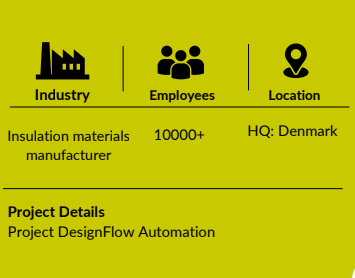
A leading global insulation materials manufacturer faced a major hurdle: their marketing team spent countless hours creating product flyers in multiple languages, often duplicating effort due to disconnected systemsand manual processes.
Our integration solutionconnected their Product InformationManagement (PIM), Digital Asset Management (DAM), and design tools (via Chili GraFx). This streamlined the entire content creation process— automating language localization, maintaining brand consistency, and saving over 1,800 man-days of creative work.
Challenges
The existing process relied heavily on manual effort. Designers recreated flyers for each market and language, pulling data separately from PIM and formatting it manually in Adobe tools. Data silos and repetitive steps led to inefficiencies, delays, and inconsistency in branding across global content.
Key Problems Identified:
- Isolated PIM, DAM, and Design systems
- Repetitive manual design work
- Inconsistent branding across geographies
- Time-consuming updates for new products
Objectives
The goal was simple yet powerful: automate flyer creation across all global markets by integrating the design tools with product data and asset libraries. This meant eliminating redundant manual steps, reducing time-to-market, improving brand control, and enabling easy localization in multiple languages without design effort.
Results
Saved 1800+ Man-Days of Design Work: By automating the repetitive task of creating multilingual flyers, the company eliminated the need for expensive creative designers to manually adapt each version. This freed up time and resources for high-value creative work, reducing overall design team fatigue and cost.
Saved 60+ Hours per Catalogue: Each product catalogue used to take over 60 hours to prepare due to manual data entry, layout adjustments, and content formatting for different markets. With the new integrated system, all fields auto-populate from PIM, and templates auto-adjust, making the process near-instant for each version.
Ensured Global Brand Consistency: The use of standardized design templates across all product flyers ensured that every customer, in any region, experienced the same brand quality and message. This not only built trust but elevated the company’s image as a global, modern, and reliable manufacturer.
Eliminated Manual Entry of 300+ Fields: Every product flyer previously required manual input of over 300 product-specific details (dimensions, certifications, usage instructions, etc.). Integration with the PIM system allowed this data to flow directly into the flyer design, cutting human error and speeding up approvals.
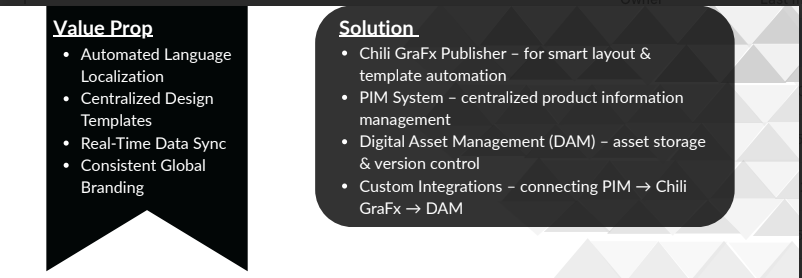
Accelerated Localization for Global Markets: Generating flyers in 20+ languages no longer required unique design efforts. Variable fields (like language, measurements, and regional compliance tags) could be adjusted automatically, helping teams go-to-market faster across regions and comply with local norms.
Streamlined Collaboration Across Teams: With PIM, DAM, and design tools now integrated, Sales, Marketing, Product, and Creative teams could work from the same system without redundant email chains or file transfers. This reduced miscommunication and version mismatches.