Why the newsroom, the stadium, and the studio need the same architecture — even when their deadlines, rights models, and operating rhythms look completely different.
By Dinesh R & Hariharan B · 12 min read · Architecture & media operations
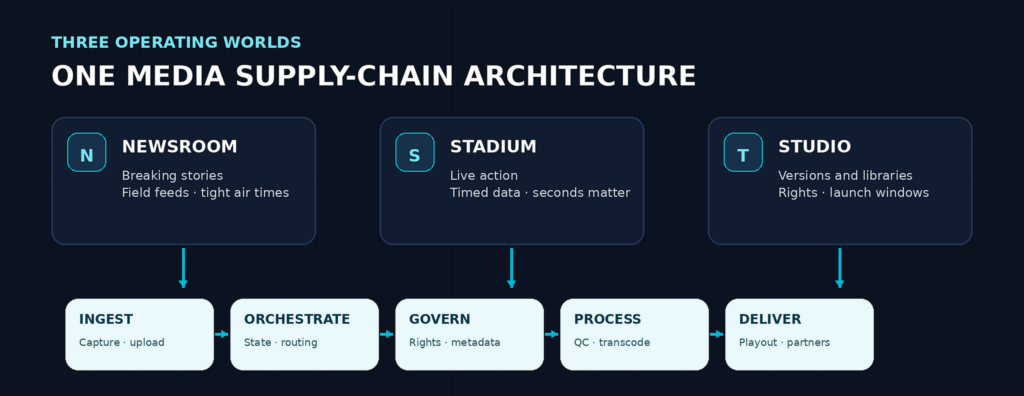
A live match has a kick-off. A breaking-news segment has an air time. A studio release has a launch window. In all three environments, the deadline is external, visible, and brutally indifferent to whatever is happening inside the technology estate.
That is why adding more operators eventually stops working. Headcount can absorb exceptions for a while, but it cannot make a fragmented chain predictable. The scalable move is to redesign the chain itself: make every hand-off explicit, every policy executable, every failure observable, and every workflow safe to resume.
The broadcasters pulling ahead are not necessarily the ones with the newest MAM, the fastest transcoder, or the most cloud services. They are the ones whose systems behave like one operating model instead of a collection of specialist islands.

The hidden bottleneck is coordination
Broadcast transformation is often framed as a tooling decision: choose a media asset manager, a quality-control engine, an archive, a transfer service, and a playout platform. Those choices matter, but they do not determine whether the operation is calm at 7:58 p.m. with two minutes to air.
The deciding factor is coordination. Which event starts the workflow? Where does its state live? Which metadata model is authoritative? What happens when a destination accepts a file but fails to index it? Who owns an exception? Can the workflow be replayed without duplicating assets or overwriting a valid version?
These are architecture questions, not connector questions. Connectors move data. Architecture makes the movement trustworthy.

The architecture in one picture
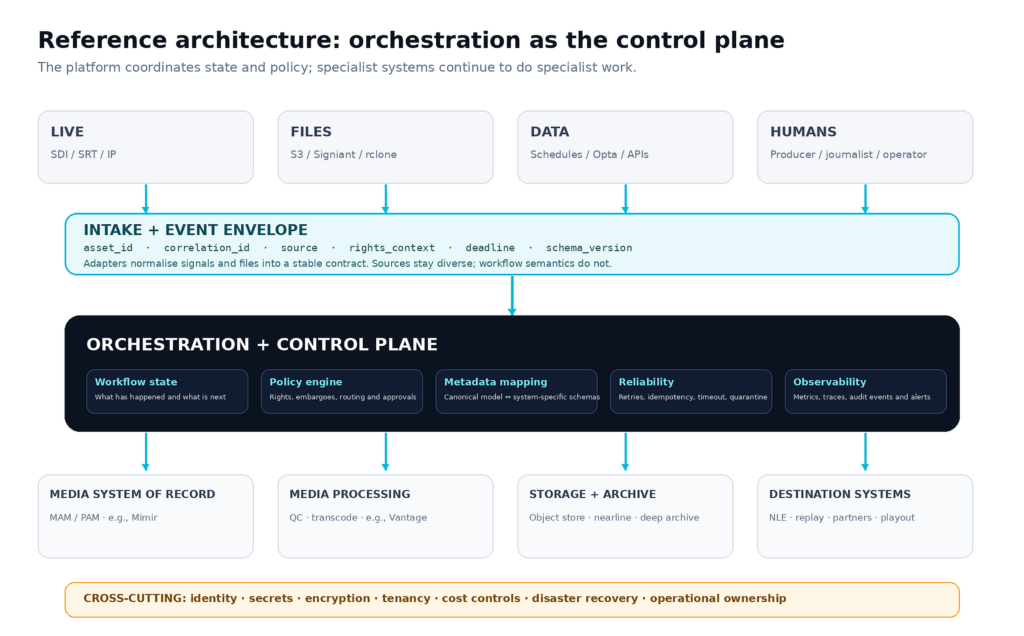
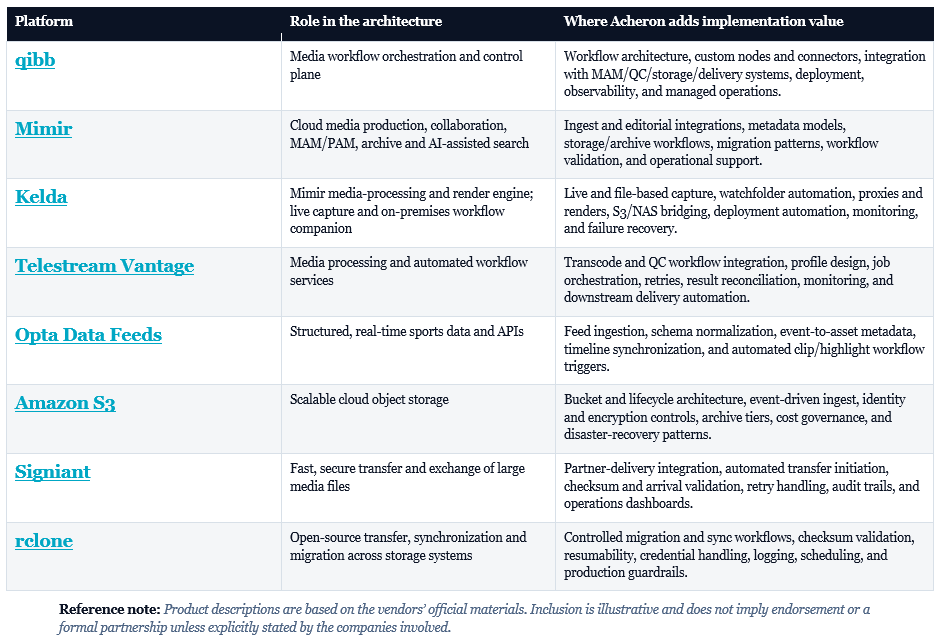
A low-code media orchestration platform such as qibb can sit in the control-plane role, connecting the estate through media-specific nodes and workflows. A cloud media platform such as Mimir can act as the searchable system of record, with Kelda supporting live capture and media processing. Telestream Vantage can provide media processing and automated workflow services. The point is not that every broadcaster needs this exact stack. The point is that each responsibility has a clear home.
When those boundaries are clean, tools can evolve independently. You can replace a transfer service, add a new distribution endpoint, or introduce a different QC engine without redesigning the entire chain. That is what good modularity looks like in a media operation: not microservices everywhere, but change contained to the boundary where it belongs.
1. Standardise the intake contract — not the sources
Live feeds, field packages, partner deliveries, promos, highlights, and archive restores will never arrive in one neat format. Trying to force every source into a single operating pattern creates brittle integrations and endless exceptions.
Instead, normalise the event that represents the arrival. Every trigger should produce a stable envelope containing an asset identifier, correlation identifier, source, schema version, rights context, expected deadline, and the location of the media or growing file. The source stays specific; the workflow contract stays consistent.
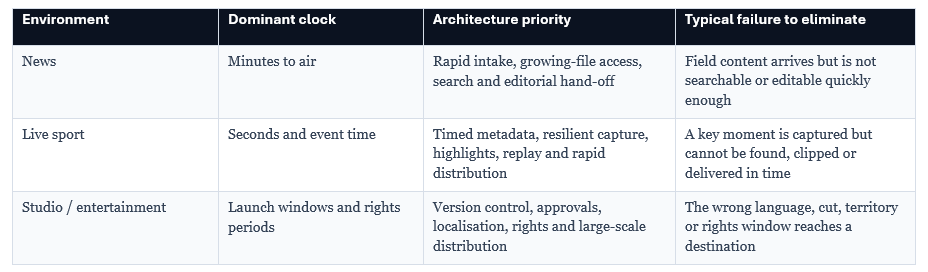
For live sport, capture may begin from a scheduled event and timed data may arrive from a provider such as Opta. For news, the trigger may be a field upload or a live incoming feed. For studio operations, it may be a package delivery with versions, languages, and contractual windows. Different inputs can still enter the same state model.

2. Make metadata a contract, not a clerical task
Metadata debt behaves like technical debt. It accumulates quietly, then appears later as broken search, incomplete rights checks, failed delivery mappings, and analytics nobody trusts.
A modern pipeline needs a canonical metadata model for the concepts that cross systems: programme, event, contributor, venue, language, territory, rights window, version, technical profile, and destination. Each platform can keep its own schema, but mappings to and from the canonical model must be versioned, tested, and observable.
Controlled reference data — people, organisations, competitions, venues, brands — should sync from authoritative sources. Operators should select governed values rather than create near-duplicates through free text. This is less glamorous than generative AI, but it is what makes search, automation, and reporting dependable years later.
AI enrichment fits here as an assistant, not an authority. Speech-to-text, scene descriptions, face recognition, and semantic tags can accelerate discovery, but their outputs should carry confidence, provenance, and review status. Generated metadata without lineage is just a faster way to create uncertainty.
3. Express rights and restrictions as executable policy
Rights management fails when the policy lives in a contract PDF, a spreadsheet, and the memory of one experienced coordinator. The workflow should be able to evaluate whether an asset can move to a destination for a territory, platform, language, and time window — before delivery begins.
Embargoes, exclusivity periods, takedown dates, and content restrictions should become rules evaluated against the canonical metadata. The system can then hold content, request an approval, route it to an alternative destination, or lift the restriction automatically when the window expires.
This changes governance from retrospective reporting to preventative control. The audit trail does not merely explain what went wrong; the policy engine reduces the chance of the wrong action occurring in the first place.
4. Design every workflow to be replayable
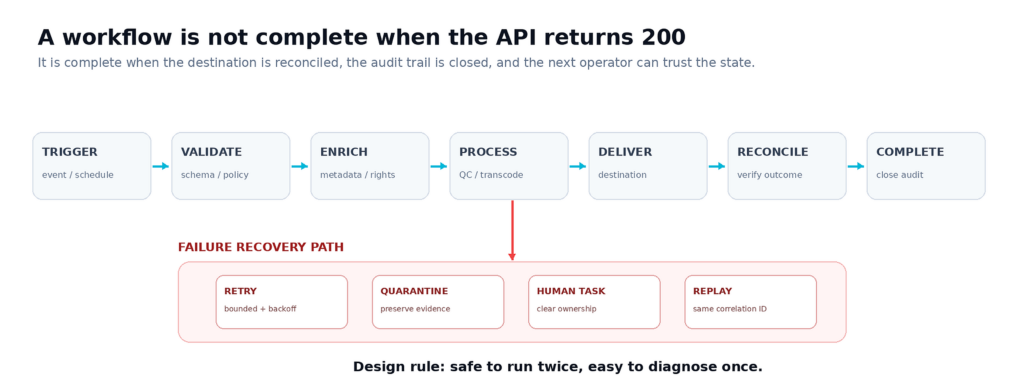
In a live operation, failure is not exceptional. Networks flap. APIs throttle. Storage tiers take time to restore. A destination can acknowledge a transfer and still fail to register the asset. The architecture must assume partial failure and make recovery routine.
Every consequential action should be idempotent: repeating it with the same correlation and business key should not create duplicate assets, duplicate deliveries, or contradictory state. Retries should be bounded and use backoff. Failed jobs should move into a quarantine state with the original payload, error, and execution history preserved.
Most importantly, human intervention should be a first-class workflow state — not an email sent into the void. The task needs an owner, context, a deadline, and a defined path back into automation.
5. Use quality control as a gate, not a report
Quality control is often automated but still operationally passive: a report is generated, attached to the asset, and left for somebody to interpret. A stronger design turns QC into an explicit decision gate.
The pipeline should know which checks are mandatory for the destination, which defects can be auto-remediated, which warnings require review, and which failures must stop delivery. Technical validation, video and audio analysis, caption checks, and format compliance can run through processing platforms such as Telestream Vantage or dedicated QC services.
The key is policy-driven progression: only content that satisfies the destination profile moves forward. When a fix is applied, the relevant checks run again and the new result is linked to the version that was actually delivered.
6. Treat playout readiness as continuous reconciliation
The last mile is unforgiving because a playlist is a promise. A file can exist in the MAM and still be unavailable on the playout server. It can be on the main server but not the backup. It can have the correct title and the wrong technical version.
That is why playout readiness should be a reconciliation loop, not a one-time transfer. When the schedule changes, the workflow compares required items with what is actually present, validates the technical profile and version, restores dormant content when needed, delivers to main and backup paths, and verifies the result before air time.
A missing item should become a controlled exception with a countdown and clear ownership — not a surprise discovered by the operator seconds before transmission.
The same architecture, tuned for three operating modes
What good looks like in production
The architecture is working when teams stop measuring activity and start measuring flow. Useful operational metrics include:
- Time from content arrival or live capture to searchable availability.
- Percentage of workflows completed without manual touch.
- Failure recovery time, separated into automated recovery and human-resolution time.
- Delivery success confirmed by destination reconciliation — not transfer completion alone.
- Metadata completeness and controlled-vocabulary compliance at each lifecycle stage.
- Rights-policy violations prevented before distribution.
- Playout items verified on main and backup systems before the readiness deadline.
These metrics expose the actual constraint. A pipeline can be technically fast and still operationally slow because approvals sit unowned, metadata arrives incomplete, or exceptions require senior engineers to decode logs across five systems.
An architecture checklist before you automate
- One business identifier and correlation ID follow the asset across every system.
- Workflow state lives in the orchestration layer and can be queried without opening five consoles.
- Metadata mappings are versioned and tested like code.
- Rights and distribution policies are executable and auditable.
- External calls are idempotent, retryable, and protected by timeouts and circuit-breaking behaviour.
- Every failure lands in a defined state with evidence, ownership, and a replay path.
- Observability connects technical events to a business deadline and destination.
- Operators can intervene without bypassing the workflow or losing the audit trail.

The payoff is operational confidence
An automated media supply chain does more than reduce manual file movement. It gives the organisation a dependable way to change. New destinations become mappings and policies instead of bespoke projects. New tools can be introduced behind stable boundaries. Operations teams gain visibility without learning the internals of every platform. Engineering teams spend less time reconstructing failures from scattered logs.
Most importantly, the chain becomes predictable under pressure. News can move faster without losing editorial control. Sport can turn live moments into searchable, distributable assets while the event is still unfolding. Studios can scale versions and destinations without turning rights management into a spreadsheet marathon.
The newsroom, stadium, and studio do not need identical products. They need the same architectural discipline: explicit contracts, an orchestration control plane, executable policy, replayable workflows, and end-to-end reconciliation.

For product teams, implementation is where adoption is won
A strong media product can still stall inside a customer estate. Legacy interfaces, metadata mismatches, security reviews, exception handling, and unclear operational ownership are where adoption slows — long after the demo has impressed everyone.
Acheron works in that hard middle. We translate platform capability into production workflows, build and maintain integrations, validate the end-to-end operating model, and stay accountable through rollout and managed services. For product teams, that means faster time-to-value, repeatable reference architectures, fewer escalations, and customers who use more of the platform they bought.
Where to start

Do not begin by attempting to replace the entire estate. Pick one workflow with visible operational pain and a measurable deadline — a live ingest path, a partner-delivery flow, an archive restore, or playout readiness. Map the states, contracts, policies, and failure modes before drawing product boxes. Then automate one vertical slice end to end and instrument it properly.
Once that pattern is proven, reuse the architecture. The fastest route to a modern media supply chain is rarely a big-bang platform programme. It is a repeatable control-plane pattern that makes each workflow simpler than the last.

Technology ecosystem and Acheron’s implementation role
The platforms below are referenced in the article text or architecture diagram. Each product name links to its official page. The implementation column shows where Acheron can help convert product capability into a reliable customer operating model.


Hariharan B
Senior Engineer @Acheron
Camunda Developer Certified, Workflow Orchestrator, AI Agent Orchestrator, Cloud Services

Dinesh R
Associate Software Engineer @Acheron
Workflow Orchestrator, Cloud Services