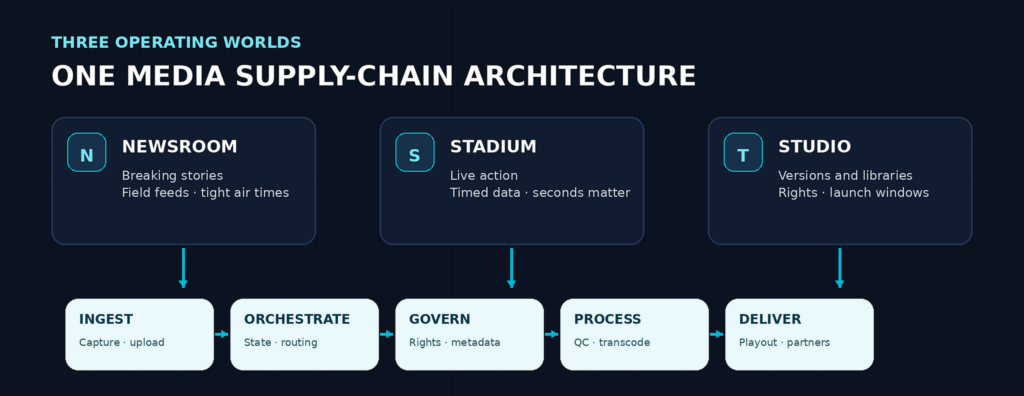
In a typical broadcast or media environment, a single piece of content rarely exists as a single file.
An episode may have multiple versions, language variants, proxies, mezzanine files, and masters. Each asset carries rights windows, territory restrictions, compliance metadata, and quality-control status. Deadlines are often tied to air dates or release schedules—leaving little room for operational failure.
At scale, managing this complexity isn’t just about storing assets. It’s about orchestrating how media moves, evolves, and becomes available.
Why Media Orchestration Became Necessary
As a broadcaster and channel partner scaled its content operations, the complexity of managing media assets began to outgrow existing workflows.
Content was arriving from multiple upstream systems in parallel. Each program existed in multiple forms—proxies, mezzanine files, masters, language variants—each governed by rights windows, territory restrictions, compliance metadata, and quality-control status. QC failures triggered rework loops, while air dates and release schedules remained fixed.
Over time, asset management became less about storage and more about coordination.
The organization operated across a fragmented landscape of MAM, DAM, rights management systems, and cloud platforms. Critical lifecycle decisions depended heavily on manual intervention and tribal knowledge, making it difficult to answer a simple operational question: What content is actually ready, compliant, and safe to deliver?
This realization prompted the need for orchestration connecting systems, governing workflows end to end, and providing real-time visibility across the media supply chain.
Why Media Asset Operations Break at Scale
Most media and entertainment organizations don’t struggle because they lack systems. They struggle because those systems operate in isolation.
A common pattern we see in broadcast and M&E environments includes:
- Ingest pipelines spanning multiple upstream systems
- Metadata arriving asynchronously or being updated repeatedly
- Manual intervention required when QC fails or rights change
- Long-running processes that span days or weeks
- Limited visibility into what is complete, blocked, or at risk
As content libraries grow into millions of assets, these challenges compound—leading to
missed deadlines, rework loops, and operational risk.
The issue isn’t tooling.
It’s coordination across the media lifecycle.
MAM and DAM Workflows Are Fundamentally Different – and Both Matters
One frequent failure mode in large media libraries is treating MAM and DAM workflows as interchangeable.
They’re not.
- MAM workflows are typically production- or broadcast-driven. They are long-running, stateful, and highly sensitive to deadlines, QC cycles, and rights availability.
- DAM workflows are often downstream and distribution-focused. They involve frequent metadata updates, approvals, reuse across regions, and marketing activation.
Real-world media operations span both—and value is lost when these workflows are managed independently.
This is why orchestration matters: media workflows don’t live in one system, and they don’t complete in one step.
Orchestrating the Asset Lifecycle - Not Just Managing Assets
Rather than building more point-to-point integrations, this solution treats the entire asset
lifecycle as a first-class workflow.
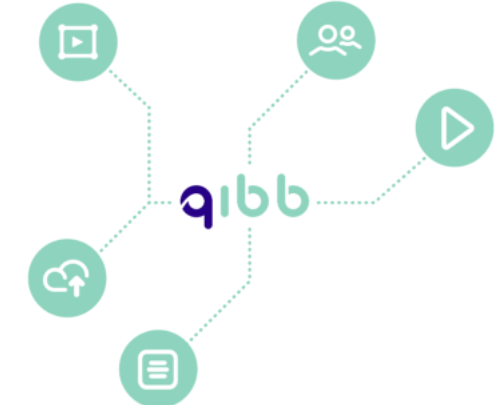
At the center is qibb, acting as the orchestration layer, with Mimir serving as the system of
record.
Together, they enable an event-driven, lifecycle-aware approach where:
- Assets are created or updated automatically based on metadata events
- Archival and purge decisions follow business and content rules
- Metadata-driven review flows enforce governance without slowing teams
- Every step is tracked, auditable, and visible
Lifecycle decisions are no longer dependent on people remembering processes.
They are enforced by design.
Why Qibb Is the Right Orchestration Layer for Media
Media orchestration starts with connectivity across the ecosystem.
qibb is particularly well-suited for media workflows because it provides a rich set of connectors across the media landscape, including:
- MAM platforms
- DAM systems
- Rights and compliance systems
- Cloud providers such as AWS and GCP
This makes it possible to connect otherwise disparate systems and orchestrate end-to-end workflows across the media supply chain, without tightly coupling platforms or introducing brittle integrations.
Building on this foundation, qibb also excels at handling the realities of media operations:
- Long-running, stateful workflows that span days or weeks
- Human-in-the-loop approvals and reviews where automation alone is insufficient
- Asynchronous, event-heavy processing driven by metadata and lifecycle changes
This combination ensures the orchestration layer remains resilient as systems evolve an essential requirement in media environments where change is constant.
Cloud-Native Scale, Designed for Media Reality
To support broadcast-scale operations, the solution integrates with AWS services in a media aware way.
Structured metadata from upstream systems is processed through Amazon S3, enabling repeatable, auditable ingest and migration workflows.
Operational state batch progress, job execution, and asset availability is tracked in Amazon RDS, ensuring the system always knows what has been processed and what remains.
In environments with strict security controls, decoupled patterns using Amazon SQS, AWS Lambda, and Amazon API Gateway allow orchestration without exposing private
infrastructure.
These architectural choices aren’t accidental they’re necessary for media scale.
Engineered for Performance Under Real Media Loads
Media operations don’t fail in theory. They fail under load. To avoid this, the solution was designed with:
- Controlled batch processing for large libraries
- Parallel execution to increase throughput
- Asynchronous workflows to eliminate blocking calls
- Synchronisation points that preserve consistency without slowing progress
This delivers predictable performance during peak ingest, migrations, and ongoing
operations.
Visibility That Protects Deadlines
Automation without visibility creates blind spots.
Using the qibb Dashboard, operations teams gain:
- Real-time insight into asset creation and updates
- Batch- and job-level status tracking
- Clear indicators of failures, retries, and delays
This visibility directly supports:
- Protecting air dates and release schedules
- Reducing firefighting between ops and engineering
- Improving trust across editorial, operations, and IT teams
Business Impact That Matters in Media
By moving from manual coordination to intelligent orchestration, media organizations
achieve outcomes that directly map to business KPIs:
- Fewer missed air dates and release delays
- Reduced rights and compliance violations
- Faster reuse of content across regions and platforms
- Clear audit trails for regulatory and partner reviews
- Lower operational overhead as scale increases
Most importantly, teams spend less time managing complexity—and more time delivering
content.
Final Thought: From Automation to Media Intelligence
Media organizations don’t need more tools. They need orchestration that understands how media actually flows.
By combining lifecycle-aware workflows, cloud-native scalability, and event-driven automation, this approach moves media operations from reactive execution to predictable,
intelligent control.
That’s the difference between managing assets and running media at scale.