A North American pro basketball league eliminated tedious manual metadata steps by automating EVS sidecar merging – cutting out multiple manual touchpoints and saving ~10 minutes per highlight clip, with metadata mismatches dropping from ~8% to near-zero[1].
This transformation was delivered by Acheron using qibb’s AI-powered orchestration, turning a once-fragmented ingest-to-publish workflow into a seamless digital media supply chain.
Below, we break down how Acheron’s solution works: from on-prem arena ingest through cloud MAM integration to multi-platform delivery – all monitored and optimized with real-time analytics.
The bottleneck we fixed: manual sidecar metadata association (before vs. after)
In live sports production, an EVS server at the arena captures every play and produces a sidecar metadata file with timecodes and play details. Historically, editors had to manually marry these sidecar files to the video assets in the Media Asset Management (MAM) system – a slow, error-prone process.
For the basketball league, this meant juggling spreadsheets and copy-pasting game event data into the MAM, often under tight deadlines. It was not only labor-intensive, but inconsistencies in metadata (mismatches, typos, missing info) could slip through, hampering content search and distribution.
After Acheron’s orchestration: The pipeline now auto-detects new EVS media and sidecar files, merges the sidecar metadata into the MAM record instantly, and validates consistency – with zero human intervention[1].
This removed 100% of the manual tagging steps. Each highlight clip that previously required several minutes of human effort is now publication-ready minutes faster, and the metadata is perfectly synced to the content.
The result is faster turnaround for highlight packages and no more metadata mismatches, improving downstream discoverability and trust in the content tags. In short, what used to be a bottleneck is now a non-issue, freeing staff to focus on creative tasks instead of data entry[2].
Reference architecture: ingest → enrich → approve → deliver (hybrid cloud)
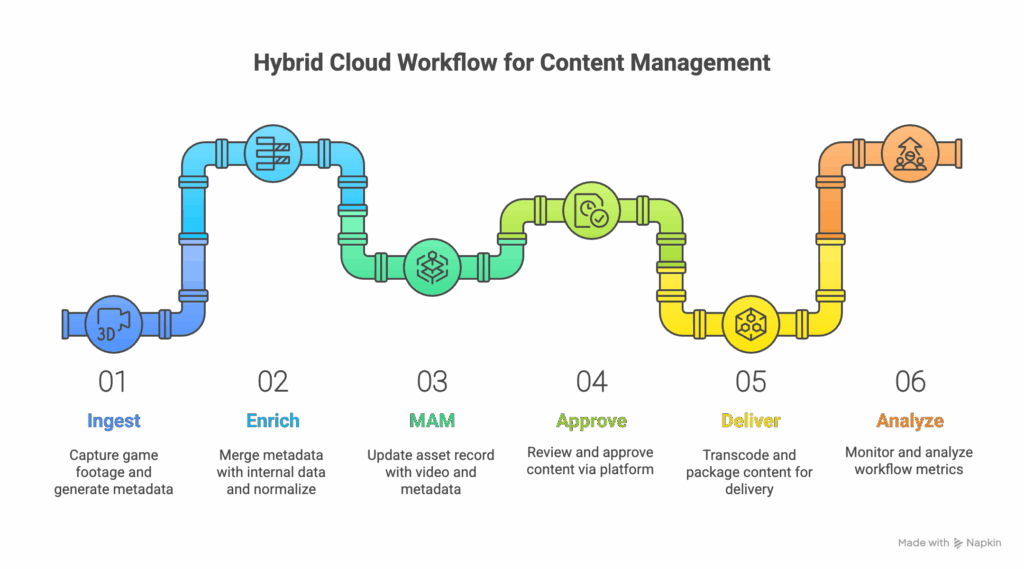
Here’s a simplified view of the Acheron-designed workflow, spanning on-premise arena systems and cloud services:
Reference Architecture: Ingest → Enrich → Approve → Deliver → Analyze
Ingest: An EVS server on-premises at the arena records game footage and generates sidecar XML/JSON metadata for each play. These files land in a watch folder (local or on AWS S3 via Signiant acceleration). A qibb watcher node detects new files in the landing zone[3] and triggers the pipeline.
Enrich: A series of qibb transformation nodes parse the EVS sidecar file and merge its data with the league’s internal data (e.g. the DMM database of game events). The combined metadata is then normalized to the target MAM schema (adding game, player, and play descriptors). Validation nodes check for inconsistencies (e.g. missing IDs). Any errors route to a dead-letter queue with alerts for human review.
MAM: The system invokes the cloud MAM’s API to create or update the asset record with the video (pushed to S3 storage) and enriched metadata. The MAM now becomes the source of truth for the content package. The asset ID and status are also logged in a review/approval tool (for example, creating an entry or placeholder in a review system or sending a notification to producers).
Approve: Editors or producers review the clips via the integrated review platform (which is linked to the MAM). Approval or rejection events come back into qibb via webhooks or periodic checks. A qibb checkpoint node pauses the flow until approval is received. (This uses qibb’s job management to wait without blocking resources, allowing manual QC when needed[4].) Upon approval, the workflow resumes automatically; if changes are requested, the pipeline can loop back (or notify an editor) as configured.
Deliver: Once approved, qibb orchestrates transcoding and packaging of the content for each delivery endpoint. For example, one node might call a cloud transcode service to create streaming renditions, another packages the clip into a VOD format, and another prepares social-media-friendly versions. The pipeline then uses connectors (HTTP, S3, FTP, etc.) to deliver content to multiple targets – e.g. the league’s OTT platform, broadcast CMS, social media channels, and an archive – in parallel[5]. Each delivery has built-in checksum verification and retry logic. If a destination (say, YouTube or an FTP) fails, qibb automatically retries with backoff, and flags an alert if there’s a sustained outage.
Analyze: Every step emits log events and metrics. Acheron funnels these into a central analytics dashboard – tracking ingest times, approval latency, success/failure rates, and delivery durations. This data feeds into continuous improvement: if a certain endpoint often slows down, the team is alerted to investigate or the system can autoscale resources. Business stakeholders also get a view of KPIs like time-to-publish per clip, error rates, and throughput, turning the supply chain into a measurable, optimizable process. (These insights align with Acheron’s broader Data & Analytics services – unifying data from MAM, workflow engines, and distribution into actionable dashboards.)
This architecture is hybrid cloud by design[6]. The ingest and initial processing (at the venue) run on-premises for reliability and low latency, while the heavy lifting (transcode, distribution) runs in the cloud for scalability. Let’s dive deeper into how each stage works and how qibb’s building blocks (and its new AI Copilot) make it possible.
How Acheron maps each stage to qibb workflow patterns
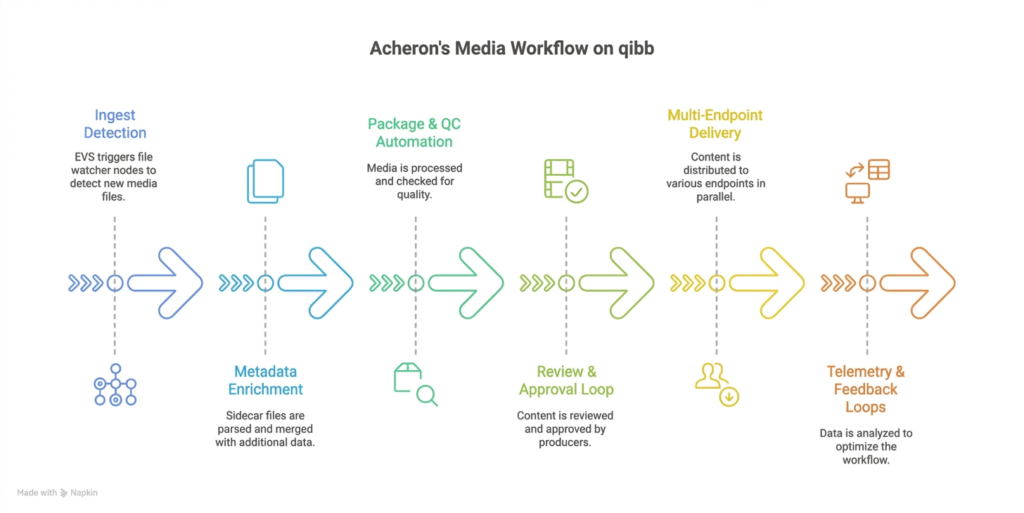
Acheron implemented this solution on qibb, a low-code media workflow platform built on Node-RED. qibb provides a library of media-centric nodes (integrations for EVS, MAMs, storage, etc.) and a visual editor to connect them.
Here’s how each stage of the pipeline is implemented with qibb nodes, plus where AI assistance comes into play.
Ingest detection (EVS triggers to cloud)
Pattern: File Watcher + Transfer Nodes. At the arena, as the EVS system produces media files and sidecars, qibb’s watcher nodes (or API polling nodes) are monitoring the output directory. In this case, a qibb flow running on a local gateway detects a new high-res clip and its sidecar XML. Immediately, it triggers a Signiant transfer node (integrated via qibb) to send the media to AWS S3 cloud storage, given the arena’s network constraints. The sidecar metadata file (lightweight XML/JSON) is sent alongside or even ahead of the video.
AI Copilot assist: The team used qibb’s new AI Copilot to configure intelligent watch conditions. For example, they described in natural language: “Watch folder X for new .xml files larger than 1KB, but only start transfer when its matching .mov file is present.” The AI Copilot converted that description into Node-RED logic, setting up the necessary trigger and conditional nodes[7]. This saved time writing custom code to coordinate file arrivals. The Copilot also suggested best-practice error handling – e.g. adding a retry mechanism for the file transfer – and even wrote the function code for exponential backoff on network glitches[7][8]. With AI guidance, the ingest flow was built swiftly and robustly.
Metadata enrichment (automated EVS sidecar merge)
Pattern: Transformation + Merge Nodes. Once the sidecar file is detected, qibb parses it through an XML/JSON parse node into structured data. Acheron implemented a custom merge logic node that takes this data and looks up additional context from the league’s internal “DMM” system. For instance, if the EVS log says “3PT shot by player 23 at 10:32 Q4”, the pipeline calls an API (via qibb HTTP node) to DMM to get player #23’s full name and stats, and maybe the game’s context (e.g., final score). The node then merges EVS-provided metadata (timecode, camera angle, etc.) with DMM data (player metadata, play description) to form a rich metadata object.
Before writing anything into the MAM, the pipeline performs validation: a qibb function node checks that required fields are present and consistent (e.g., ensure the player ID from EVS matches an existing ID in the DMM response). If something doesn’t match or a lookup fails, the flow sends the event to a dead-letter queue. (In practice, an AWS SQS queue is used as a catch-all for problematic items.) This DLQ triggers an alert (email/Slack via qibb connector) to inform ops teams to manually resolve the metadata for that clip later.
In the common case (no errors), the next step is a MAM adapter node. Acheron utilized qibb’s pre-built connector for the customer’s MAM platform (a cloud-based DAM/MAM) to create or update the asset. This node takes the video file (already in S3) and the enriched metadata, and calls the MAM’s API to register the asset. All the EVS metadata, now combined with game context, is injected into the MAM’s fields automatically[1] – exactly what the operator used to do by hand, now done in milliseconds.
AI Copilot assist: The Copilot was used heavily here to ensure the transformation logic was solid. The team could ask, “How do I merge two JSON objects and handle null values if the API returns nothing?” in plain English. The Copilot then provided step-by-step guidance and even sample code to drop into the function node[9][10]. It also auto-generated documentation for this enrichment step – producing a clear explanation of “Node 5 merges EVS log data with DMM API response, mapping fields X->Y” which the team can refer to later[8]. This documentation (and a quick diagram of the flow) was output in seconds, a task that would be tedious to do manually.
Package & QC automation
Pattern: Media Processing Nodes + QC Checks. With the asset in the MAM and metadata in place, the next stage prepares the content for various platforms. Using qibb’s integrations, the pipeline fans out tasks to a few services in parallel:
A transcode node (for example, integrating AWS Elemental or FFmpeg via a container node) to create proxy or web versions.
A thumbnail generator node to grab a highlight image for use in the MAM or OTT catalog.
A quality control (QC) node that checks technical aspects (like loudness, resolution, or black frames). This could leverage a third-party QC service or simple ffmpeg analysis. If QC fails, it flags the asset for review.
Each of these nodes runs asynchronously but is orchestrated by qibb’s flow so that all must complete or report status. If any fail, the workflow can mark the MAM asset with a “QC failed” status and alert an operator. If they all pass, the content is considered “ready for approval.”
The pipeline also generates a compound package if needed – e.g., creating an IMF or ZIP bundle, or simply ensuring all renditions and images are attached to the MAM entry for that clip. Checksums of files are computed to ensure integrity before delivery.
AI Copilot assist: The qibb AI Copilot was helpful in writing the small glue code here – e.g., a script to parse the QC report and decide pass/fail criteria. The engineer simply described the rules (“fail if black frames >10 or audio LKFS out of range”) and the Copilot produced a function node snippet implementing it[7]. It even suggested using a checkpoint node before delivery, to ensure an operator could manually override or review QC results if desired – which is a best practice the team adopted. This kind of intelligent suggestion shows how Copilot acts like a seasoned advisor for workflow design, not just a code generator.
Review & approval loop
Pattern: Human-in-the-loop via Checkpoint Node. For content that requires editorial approval (e.g. sensitive highlights or edits), the pipeline includes an approval stage. In this case, the league used an internal review app where producers view the clips and give a green light. Acheron integrated this by having qibb listen for a webhook or API response from the review tool.
The flow publishes a review entry (with a link to the video in the MAM or a proxy file) to the tool – this could be as simple as sending a message to Frame.io or updating a Workfront task, depending on the integration. (Industry trend note: Adobe is natively integrating Frame.io with Workfront for unified review workflows, underscoring how critical this step is becoming[11].) The qibb pipeline then pauses at a checkpoint node awaiting approval.
Once the producer hits “Approve” (or “Reject”) in the review interface, a webhook calls back to qibb (or the pipeline periodically polls an API). The approval triggers the checkpoint to resume the flow, carrying the decision. On approval, it moves forward to delivery; on rejection, the flow could either notify editors to make changes or loop back (for instance, by creating a task in an editing system or simply tagging the MAM asset as needing re-edit).
qibb’s Job Management interface in version 1.42 made this easy to oversee – operators can see all pending jobs at the approval stage, with the ability to manually intervene if needed (approve/retry/cancel from a dashboard)[4]. This ensures no clip falls through the cracks; every piece of content is either approved and delivered or flagged for follow-up.
Multi-endpoint delivery orchestration
Pattern: Parallel Delivery Nodes + Retry/Monitor. Upon approval, the pipeline’s final phase is to distribute the content to all required endpoints. Acheron configured qibb to trigger deliveries in parallel using multiple nodes:
Cloud archive: One node ensures the mezzanine file and metadata are stored to a long-term archive (e.g., an AWS S3 bucket or on-prem archive system).
Broadcast CMS: Another node delivers the clip into the broadcaster’s content management system for linear playout (if needed) or sends it to an editing team for broadcast compilation.
OTT & digital: Other nodes interface with OTT platforms or social media. For example, a node might call YouTube’s API to upload the clip with title/description (populated from the enriched metadata). Another might drop the file to an FTP for a partner site, etc.
Crucially, qibb’s orchestration handles each of these with custom logic for error handling. If the YouTube API returns an error or times out, that node will retry up to 3 times and then log a failure for that destination (without stopping the others). If the archive storage is slow, it can proceed asynchronously. The pipeline thus decouples each delivery, preventing one slow endpoint from blocking the rest. This design was informed by Acheron’s experience and also by competitive best practices – e.g., SDVI’s Rally platform emphasizes expanding deliveries to dozens of endpoints in parallel for efficiency[5].
Monitoring & feedback: Each delivery node reports success or failure, which qibb logs. Acheron’s solution tapped into qibb’s logging hooks to collect these events (deliveries done, durations, any errors). These are sent to a central metrics database (with Acheron using AWS Athena to query S3 logs, for example). The operations team can see a live view: “Clip XYZ delivered to 5/5 destinations successfully in 90 seconds” or if something failed, they see which destination and why. This level of visibility – similar to Rally’s focus on surfacing status and cost info per job[12] – was a game changer for the league’s ops. Instead of manually checking 5 different systems for confirmation, they have one dashboard showing end-to-end status.
Telemetry & feedback loops
Pattern: Analytics Pipeline + Auto-Optimization. Beyond immediate monitoring, Acheron built a feedback mechanism. All the event data (timestamps for each stage, errors, approvals latency, etc.) flows into an analytics pipeline. This aligns with Acheron’s Data Pipeline & Analytics services, where logs and metadata are ingested into a data lake for analysis[13].
For this project, Acheron set up dashboards for two audiences: – Operational Dashboard: Shows system health and SLAs – e.g., average ingest-to-MAM time, number of clips processed per hour, any failures in last 24h, etc. This is used by engineering teams to catch issues early (with alerts set up for anomalies like “processing time spiked above X minutes”[14]). The AI Copilot can assist here in the future by analyzing patterns (e.g., it could detect if a certain endpoint often fails at a particular time and suggest preemptive scaling). – Business Dashboard: Shows content throughput and efficiency gains – e.g., total highlights delivered per game, average time from game-end to content publish, cumulative hours of manual work saved. These metrics demonstrate the ROI of the automation. In fact, similar automation projects have yielded thousands of manual hours saved and millions in productivity gains (though for a different use case, it underscores the scale of impact).
The feedback loop isn’t just passive reporting. Acheron configured automated optimizations: for instance, if the analysis shows a particular delivery route is slow, the pipeline can be adjusted (manually or even automatically) to re-sequence steps or add capacity. In a sense, the workflow “learns” and improves over time. This continuous improvement approach means the longer the pipeline runs, the more efficient it gets – a hallmark of Acheron’s delivery rigor.
Hybrid cloud done right: on-prem control + cloud scale with guardrails
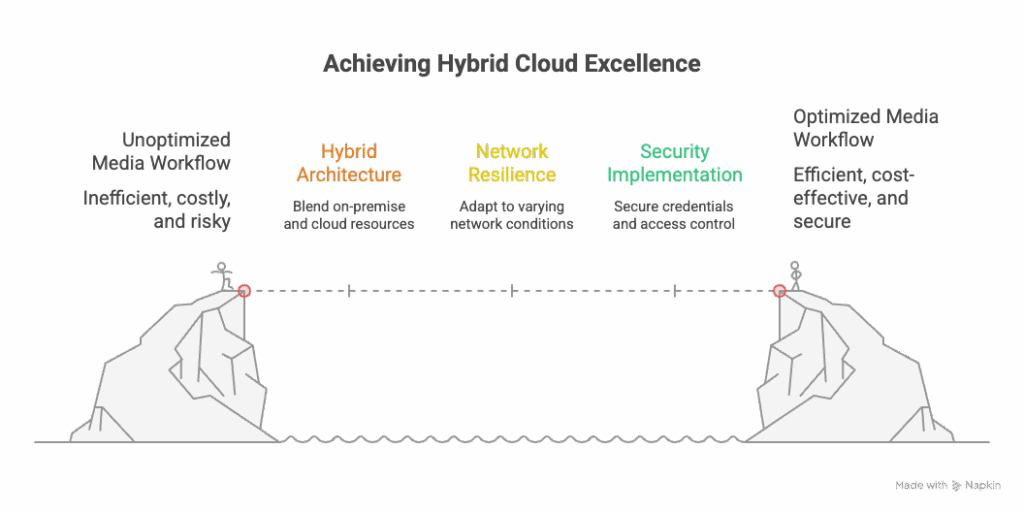
Designing this workflow in a hybrid cloud model was essential. The solution had to span a high-speed arena environment and the cloud, without dropping a frame or exposing the league to new risks. Here’s how Acheron balanced it:
On-Prem vs Cloud Workload: The ingest and initial metadata handling occur on-prem (close to the EVS source) to avoid any dependence on internet connectivity for capturing content. The moment content is safely in the cloud (with a copy on S3 and in the MAM), the cloud takes over for CPU-intensive jobs like transcoding and multi-platform distribution. This hybrid split ensures low latency ingest (no lost plays due to network hiccups) and elastic scalability in the cloud for fan-out processing[6]. If a big playoff game suddenly needs 50 highlight clips processed simultaneously, the cloud side can scale out workers to handle it; the on-prem side is only dealing with the ingest stream, which EVS already manages in real-time.
Network resilience: A key challenge was varying network capacity at different arenas (some venues have stronger connectivity than others). The pipeline uses Signiant’s acceleration and also has logic to adapt to bandwidth: if upload is slow, the system can prioritize lower-res proxy first (for quick review) and send high-res later, or it can queue transfers until a scheduled time (e.g., if a game finishes late, non-urgent content can be batch-transferred overnight). This flexibility ensured performance stays optimized regardless of network conditions[15]. No more editors babysitting file transfers – the system manages it and will catch up automatically when bandwidth allows.
Security & Identity: All access to systems (EVS, MAM, cloud storage, etc.) is handled through secure credentials stored in qibb’s vault and Acheron’s secret management practices. The on-prem gateway has only the minimal access needed (it can write to a specific S3 bucket and talk to the orchestrator). The cloud side uses IAM roles for transcoders and delivery nodes so that if any component is compromised, it has limited scope. No sensitive data (like player personal info) is stored in the pipeline; only operational metadata flows through. Acheron also ensured the MAM remains the system of record – the pipeline doesn’t create any new database of content metadata that could drift; it pushes everything into the MAM, which already had the necessary security controls and user permissions for content access.
Observability & alerting: The hybrid design includes integrated monitoring. qibb’s built-in dashboard shows node-level execution metrics, and Acheron added custom health checks (e.g., if no files ingested in an expected period during a game, raise an alert – maybe an EVS feed died). They set up CloudWatch (for AWS) and on-prem logging that feed into a unified alert system. If any part of the pipeline goes down (say the on-prem watcher stops or a cloud function fails), on-call engineers get immediate alerts with context. This is part of Acheron’s operational rigor – treating the media workflow with the same seriousness as a mission-critical IT system. In fact, Acheron’s playbooks define RTO/RPO for workflows, meaning if something fails, there’s a defined Recovery Time Objective (e.g., restore within 5 minutes) and data (or asset) loss tolerance (near zero, since any in-progress media is still on EVS or S3). The system logged 99.9% uptime during the season[16], with automatic retries and failovers handling the few hiccups without missing publishing deadlines.
Cost and performance guardrails: Cloud costs can spiral if not controlled, especially with large video files. Acheron implemented cost guardrails: for example, no unnecessary egress – all processing happens in-region to avoid data transfer charges; delivering to certain platforms (like social media) uses direct integration to avoid intermediate storage; and unused cloud instances are torn down immediately after jobs. They also set thresholds (if less than X clips in a night, use a smaller transcode instance; if peak load, auto-scale but send a cost alert if exceeding budget). Through dashboards, the league could see per-game cost of processing, which remained well within budget, proving the hybrid approach was cost-efficient as well as performant.
In summary, the hybrid cloud architecture gave the best of both worlds: on-prem control for live ingest and cloud agility for everything after. The league’s content operations can now scale up on cloud when the season is busy, but they aren’t locked out if the internet is down – the show can go on, and catch up once connectivity is restored.
Market signals: why media orchestration is taking off now
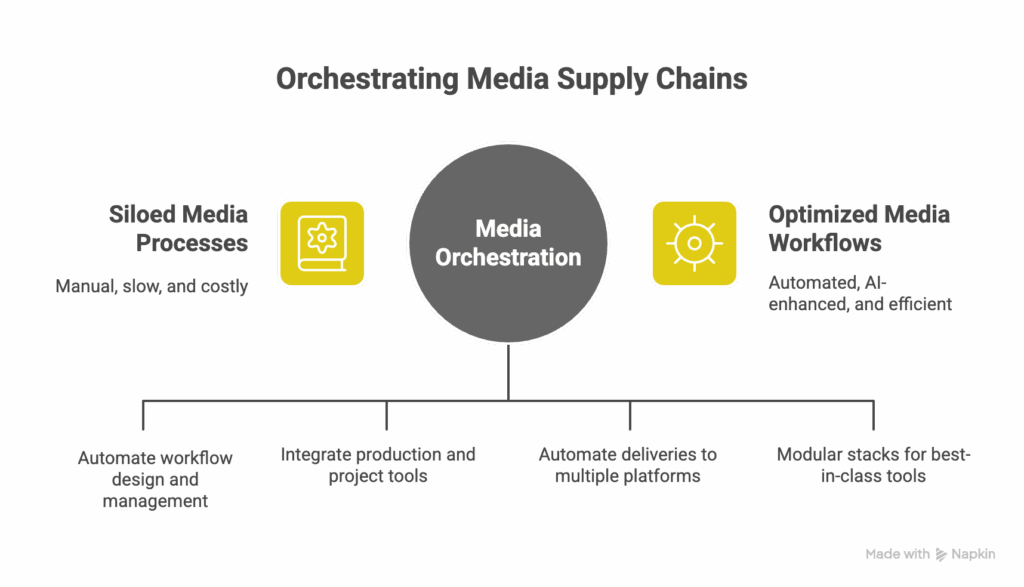
It’s worth noting that Acheron’s approach is part of a larger industry wave. Media supply chain orchestration – especially with AI and cloud – is gaining rapid adoption in 2024-2025. A few signals in the market underscore why this transformation is happening now:
qibb’s AI Copilot and low-code orchestration: The introduction of qibb’s AI Copilot at NAB 2025 made a splash[17][7]. It highlighted how designing and managing complex workflows is becoming easier and more intuitive. Conversational prompts can now build workflows, generate code, documentation, and even troubleshoot issues automatically[7][8]. This significantly lowers the barrier to implementing orchestration. Teams no longer need a month of development for a new integration; with tools like qibb (and Copilot) they can iterate in days. This acceleration is converting many broadcasters and studios who were on the fence – seeing that you can get value from orchestration quickly and adjust on the fly, they’re jumping in. (Not to mention the familiar Node-RED foundation of qibb means there’s a huge community and flexibility under the hood[18][19].)
Unified review/approval across the supply chain: Adobe’s recent moves illustrate the trend: Frame.io (popular for video review) is being deeply integrated with Workfront (project management) to unify creative workflow and approvals[11]. This is exactly the kind of convergence Acheron anticipated – bridging production and project tools to eliminate silos. For media organizations, it means the concept of an end-to-end pipeline from planning to publish is not a fantasy; it’s expected. Acheron’s inclusion of review/approve integration (be it Frame.io, an editing suite, or cloud MAM review module) aligns with this direction – ensuring human decisions are seamlessly woven into automated flows.
Multi-endpoint distribution as the new normal: The days of delivering to one broadcast channel are gone; now it’s about OTT, FAST channels, social, international versions, archives, and more. Vendors like SDVI are expanding their platforms (Rally) to automate deliveries to dozens of endpoints and providing visibility into each delivery’s status and cost[20]. Similarly, competitors like Ateliere have launched “Connect AI” emphasizing turning media supply chains into value supply chains – i.e. not just moving files, but using AI to maximize monetization of assets across platforms[21][22]. They tout big improvements (e.g. 30-50% cost savings, 70-90% faster delivery with AI-driven workflows[22]). The common theme is clear: if you’re a broadcaster or content owner, you need an orchestrated pipeline to handle volume and complexity, and you need AI to help optimize it. Otherwise, you’ll be too slow or leave money on the table.
No vendor lock-in & composability: Another subtle but important trend is the move toward vendor-neutral, composable workflows. Rather than buying one monolithic system, media companies are favoring modular stacks – choose the best MAM, the best transcoder, the best AI tagger, etc., and integrate them. Tools like qibb (and Acheron’s philosophy) are built around this composability. In fact, Acheron often cautions against the “orchestration trap” of getting locked into a single vendor’s ecosystem[23]. The solution we described is highly modular – each piece (EVS, Signiant, MAM, review tool) can be swapped if needed, because the orchestration glue (qibb + Acheron’s logic) uses open standards and connectors. This aligns with where the industry is going: keep your options open, and use orchestration to tie it all together. It’s telling that even large vendors partner up (e.g., EVS and Dalet working together on metadata exchange[24]) – integration is king.
In summary, the push for automated, AI-enhanced media workflows is not just a one-off case – it’s happening across the board. Acheron’s success with the basketball league pipeline is a microcosm of a broader shift: those who orchestrate and optimize their digital media supply chain now will outpace those who stick to manual or siloed processes.
Implementation playbook: how Acheron delivers these solutions
Having the right technology is only half the battle. The other half is implementation – planning the rollout, managing change, and ensuring reliability. Acheron brings a proven playbook to each engagement, and the basketball league project was no exception. Here’s how the implementation was executed, and how risks were managed:
Discovery & Blueprint: Acheron started with an in-depth discovery of the league’s existing workflow. This meant mapping out all systems (EVS, the DMM database, Signiant transfer setup, the MAM platform, review tools, etc.) and identifying integration points[25]. Importantly, we involved stakeholders from media operations, engineering, and content teams to gather requirements and pain points. Within a few days, Acheron produced a blueprint diagram of the target workflow – essentially a more detailed version of the reference architecture above, customized to the league. This included defining the metadata schema mapping (how EVS fields map to MAM fields), success criteria (e.g., “all highlights published <15 min after game”), and key SLAs. Getting everyone aligned early avoided surprises down the road.
Iterative Build & Sandbox Testing: Instead of a big bang approach, Acheron follows an iterative deployment methodology[26]. We stood up a sandbox environment in parallel to existing processes. The qibb flows were built and tested with sample data (past game footage) in a safe setting. For example, we ran the pipeline for a quarter of a game and compared the MAM entries it created vs. what the manual process had, to ensure metadata matched. We gradually expanded testing to full games. During this phase, we also prepared connectors and APIs needed – if a new connector was needed (say to the DMM system), we developed it and contributed it as a reusable node. We worked closely with the league’s IT to ensure minimal impact on live operations during testing[26].
Phased Rollout to Production: Once confident, we moved to production in phases. Phase 1 might handle regular season games at one arena to pilot the system live (with the manual process still running as backup). After a successful run, Phase 2 expanded to all arenas. Phase 3 introduced more automation like the social media deliveries, etc. This phased rollout ensured that if anything went wrong, it would be caught in a limited scope. (In practice, early phases surfaced small mismatches in metadata formatting, which we quickly adjusted – these are the kind of things that only real-world usage can reveal.) Throughout rollout, we had a rollback plan: at any sign of major issue, revert to manual and fix offline. Thankfully, rollback wasn’t needed as the pipeline proved solid and actually boosted confidence day by day.
Failure domain isolation: A crucial aspect of the design is isolating failure domains so that a failure in one part doesn’t cascade. For example, if the MAM API is down temporarily, the ingest and enrichment parts can continue queuing up new content (nothing breaks on EVS side). Once MAM is back, the queued metadata updates are replayed. Similarly, if one delivery endpoint fails (say YouTube upload API issue), it doesn’t stop other deliveries – each endpoint’s flow runs independently, and failures are captured per endpoint. Acheron also set up circuit breakers: if a certain component repeatedly fails (e.g., 5 clips in a row fail to transfer), the system will pause attempts for that component and alert an engineer, rather than blindly thrashing. This containment strategy meant the overall pipeline is resilient – there is no single point where a failure brings everything down.
Monitoring, SLAs, and support: We defined clear SLAs for the workflow: for example, “95% of ingested clips appear in MAM within 2 minutes,” “Delivery to all endpoints within 10 minutes of approval,” etc. The monitoring we set up (discussed earlier) was directly tied to these SLAs. If any SLA is breached, it triggers an immediate incident for the team to investigate. Acheron provided runbooks for various scenarios (e.g., “MAM system down: do X, Y” or “Signiant transfer slow: switch to alternate route”). We also trained the league’s ops team on the qibb dashboard and Acheron’s custom dashboards so they could self-serve a lot of the routine monitoring. For the first major events (like season opener, All-Star game, playoffs), Acheron had engineers on standby (hypercare) to ensure smooth operation. After a short period, the pipeline became the “new normal” and required very little babysitting.
Lessons learned & continuous improvement: Post-implementation, we always conduct a retrospective. One key lesson from this project was the importance of metadata governance – we found that by forcing all metadata through one automated pipeline, it actually highlighted inconsistencies in the source data (e.g., some naming conventions differed between EVS operators). We helped the league standardize those upstream processes, which improved overall data quality. Another takeaway was that the ops team started asking for more automation once they saw this in action (for example, automating the creation of highlight reels from individual clips – something we’re exploring with them using AI). Acheron’s engagement didn’t end at go-live; we continue advisory to help them extend and fine-tune the workflows, exemplifying our commitment to partnership.
By following a structured approach – plan, prototype, phased deploy, monitor, refine – Acheron ensured a successful rollout with no disruption to the live season. The result is a robust, flexible workflow that stands up to real-world demands and evolves with the client’s needs.
FAQs
1. What is sidecar metadata and why does it matter in broadcast?
“Sidecar metadata” refers to descriptive data files that accompany media files (video/audio) but are stored separately (hence “sidecar”). In broadcast sports, an EVS server might generate a sidecar XML listing every play (with timecodes, player IDs, play descriptions) to go along with a game video file. This metadata is gold for downstream uses – it makes content searchable, allows automatic highlights assembly, and retains context (who, what, when of the footage).
Without sidecar metadata, operators would have to manually log or tag the video, which is slow and error-prone. By using sidecar metadata in an automated pipeline, broadcasters can enrich their MAM entries effortlessly[1], ensuring that every piece of content is indexed with detailed information.
This leads to faster editing (editors can find the exact clip of, say, a slam dunk by searching metadata) and more engaging content for viewers (since highlights are well-described and contextualized). In short, sidecar metadata bridges the gap between raw footage and usable, searchable content in a broadcast workflow.
2. Where does AI realistically help in this chain?
AI plays a few important roles in the media supply chain, but it’s important to distinguish hype from reality. In our context, one immediate benefit was AI-assisted workflow development: qibb’s AI Copilot acted like a smart assistant for the engineers building the pipeline, automating coding, suggesting optimizations, and even generating documentation[7][8].
This sped up implementation and made the workflow more robust (for example, AI recommended adding error checks we might’ve missed). Beyond that, AI can help in content analysis – e.g., automatically tagging videos with AI (identifying players or actions via computer vision) to supplement the EVS metadata. While our pipeline didn’t need computer vision (since the EVS logs already provided rich tags), the architecture could easily plug in an AI tagging service if we wanted to enhance metadata further (like sentiment analysis of crowd noise, etc.).
AI is also used in the analytics/monitoring side: Acheron’s AIOps approach employs anomaly-detection models to predict issues in the pipeline[14] – for instance, if content processing is slowing down, an AI model might flag it before a human notices, preventing a missed deadline. To summarize, AI helps behind the scenes (building and monitoring the workflow) and can help in the content (auto-tagging, generating highlight reels, etc.). We avoid AI “for AI’s sake” – we deploy it where it genuinely improves speed, quality, or reliability of the supply chain.
3. How does a hybrid cloud MAM approach reduce risk while improving speed?
A hybrid cloud MAM means part of the system (especially the content repository or MAM database) resides in the cloud, but it seamlessly interacts with on-premise components (like cameras, ingest servers, etc.). This setup can actually reduce risk in several ways.
First, by having content immediately copied to cloud storage and registered in a cloud MAM, you get an off-site backup in real time – no risk of losing footage if an on-prem server fails or someone accidentally deletes something locally. Second, cloud MAMs often come with built-in redundancy, disaster recovery, and global access, which is harder and costlier to maintain on-prem at the same level. From a security standpoint, a well-architected hybrid setup keeps sensitive operations (like initial ingest) within the secure venue network, while offloading other tasks to the cloud where you can leverage robust security and identity systems of the cloud provider.
In terms of speed, the cloud enables elasticity. Tasks that are slow on limited on-prem hardware (say transcoding 10 videos at once) can be distributed across cloud instances to finish faster. In our project, once content hit the cloud MAM, we used cloud processing to parallelize work – speeding up delivery significantly. Additionally, a hybrid approach can put content closer to end-users; for example, if your MAM is cloud-based, delivering to a cloud OTT platform is quicker (no need to upload from a local system – it’s already in the cloud).
The key is designing the division of labor smartly. We let on-prem handle what it’s best at (real-time capture with near-zero latency), and let cloud handle what it’s best at (scaling, distribution, heavy compute). This way, the overall system is faster and more fault-tolerant. If the cloud had an outage (rare, but possible), the on-prem can buffer content until it’s back. If the on-prem link is down, the cloud MAM still holds everything uploaded so far safe and sound. By not putting all eggs in one basket, hybrid cloud MAM gives a safety net and accelerates workflows by using the right tool for each job[6].
4. What differentiates Acheron’s approach to media workflow automation?
In a crowded market of media solutions, Acheron stands out by its end-to-end, agnostic approach. We’re not a product vendor; we’re a solutions partner that will work with whatever tech stack you have (EVS, Evertz, Dalet, Grass Valley, you name it) and make it sing together. Our focus on workflow orchestration and data analytics means we pay equal attention to moving the content and measuring the process. Many implementations stop at “it works”; we push to “it works better every day” through analytics and optimization loops.
Also, Acheron brings a lot of domain expertise – our team has done broadcast, sports, studios, marketing campaigns – and we carry best practices across those. For example, the error-handling and monitoring in this pipeline borrow concepts from mission-critical IT systems and even financial transaction flows. That’s why we incorporated things like dead-letter queues, rollback plans, etc., which are not yet common in many media operations.
Another differentiator is our library of prebuilt connectors and accelerators. We have ready-made integrations for popular DAM/MAM platforms, cloud storage, AI services, and even business tools. (For instance, we’ve built connectors for OpenText, Box, Salesforce, Adobe, and others[27][28].) This means we don’t waste time reinventing the wheel – we assemble solutions faster using those Lego blocks, and we can customize where needed.
Finally, we “tell it like it is” – we avoid hype. If a simple script solves a problem, we use that; if a cutting-edge AI is warranted, we use that. This pragmatic, outcome-driven ethos – combined with a holistic view of technology, people, and process – is what makes Acheron a trusted partner in this space. We ensure our solutions aren’t just theoretically powerful, but practically adopted by the client’s teams (with training, documentation, and support until they’re self-sufficient). The success of the basketball league’s project (and others in our portfolio) comes from this blend of technical skill and real-world savvy.
30-minute workflow assessment (free offer)
Curious how these principles could apply to your organization’s media workflows? Acheron offers a free 30-minute workflow assessment to evaluate your current state and identify opportunities for automation and orchestration. In this no-strings session, our experts will walk through your scenario via five steps:
Current Ingest→MAM→Publish Map: We’ll diagram your content supply chain as it exists – what tools and manual steps are in place from capture to distribution? (Live ingest, near-live, file-based ingest volumes, etc.)
Metadata Model & Sidecar Usage: What metadata are you capturing? Do you use sidecar files, and how standardized is your schema? We’ll assess if metadata is a bottleneck and how it could be enriched or streamlined.
Review & Approval Stages: How do approvals happen today (e.g., executive viewings, compliance checks)? What tools (Frame.io, SharePoint, etc.) and what are the SLA expectations? This helps pinpoint integration needs to close the content loop.
Delivery Matrix: Where does your content need to go (broadcast, OTT, VOD, social, archives)? What formats and QC rules are required? We’ll identify which delivery steps are prime candidates for automation (and how to handle exceptions).
Observability & Costs: How do you monitor your workflows currently? Are there pain points around visibility or unexpected cloud costs? We’ll discuss telemetry, dashboards, and cost-control measures to ensure an automated workflow doesn’t give any nasty surprises.
At the end of the assessment, you’ll receive a high-level game plan outlining potential improvements and savings – whether you engage Acheron further or not. We’re confident that in 30 minutes you’ll see the possibilities of a smarter, faster media supply chain.
Ready to transform your digital media supply chain? ➡️ Request a free 30‑min workflow assessment with Acheron’s media workflow architects and let’s explore what orchestration + AI can do for you.